
The Ultimate Guide to FSMA 204 Compliance for Food Manufacturers, Processors, Distributors, and Suppliers (2026–2028 Edition)
(Written by the EDI Support LLC team with 100+ years of EDI implementation experience)
Published July 2026
The Ultimate Guide to FSMA 204 Compliance for Food Manufacturers, Processors, Distributors, and Suppliers (2026–2028 Edition)
(Written by the EDI Support LLC team with 100+ years of EDI implementation experience)
Published July 2026
Everything Food Manufacturers, Distributors, Processors, Packers, and Suppliers Need to Know About Preparing for the FDA Food Traceability Rule Well Before the Deadline.
Note: This guide is educational and reflects what we know as of July 2026. It isn’t legal advice. FSMA 204 requirements and retailer programs change, so confirm the current details against the FDA’s Food Traceability Final Rule and your trading partners’ published specs.
Key Takeaways
- FSMA 204 (the FDA’s Food Traceability Final Rule) requires businesses that manufacture, process, pack, or hold foods on the FDA’s Food Traceability List (FTL) to keep enhanced, lot-level records and hand them to the FDA in an electronic, sortable format within 24 hours of a request.
- The federal compliance deadline was extended from January 20, 2026 to July 20, 2028. Congress made that date binding in November 2025. The rule itself did not change, only the date did.
- Do not treat the extension as a break. Your real deadline is often your largest retailer, not the FDA. Walmart and Sam’s Club already require FSMA 204 data on shipments as of August 1, 2025, and chargebacks are being assessed today.
- Most companies already collect the required data. The hard part isn’t collecting more data, it’s connecting data that lives in separate systems (ERP, WMS, shipping, EDI, spreadsheets, email).
- EDI is where a lot of this becomes real: retailer traceability data rides on the EDI 856 ASN, tied to GS1 barcode labels. This is exactly where Elevate helps and where we partner with traceability specialists like Starfish Network and TrackVision AI.
What FSMA 204 Actually Is (And the Mistake Almost Everyone Makes)
When people first hear about FSMA 204, they slot it into the “another compliance project” folder in their head. Another regulation, another pile of records, another deadline to dread. That’s the wrong way to think about it, and it usually leads to a fragile, last minute scramble.
The rule really changes how you think about traceability. Not because you suddenly need to collect a mountain of new information, but because you need to connect the information you already have. When a retailer or the FDA calls and asks where a specific lot came from, where it went, and who touched it along the way, you need to answer quickly and confidently. For a lot of companies, that question is where the trouble starts.
The formal definition of FSMA 204
FSMA Section 204, formally the Food Traceability Final Rule, lives in 21 CFR Part 1, Subpart S and carries out Section 204(d) of the 2011 Food Safety Modernization Act. It was published back in November 2022. What it does is expand the recordkeeping requirements for certain higher risk foods so that contaminated product can be found and pulled off shelves faster.
The point isn’t paperwork for its own sake. The point is speed. Right now, tracing a contaminated food back to its source can take days or even weeks. The rule is designed to get that down to hours, which means fewer people get sick and far less good inventory gets destroyed alongside the bad.
Why Was FSMA 204 Created?
Every year, food recalls ripple through the whole chain, hitting consumers, retailers, distributors, and manufacturers. And when contaminated food gets into the system, investigators often spend days, sometimes weeks, piecing together where it came from and where it went.
Every hour of that delay makes things worse:
- Affected product sits on shelves longer, so more people get sick.
- Companies end up recalling far more than they need to, because they can’t isolate the exact lots.
- Businesses lose time and money, and they lose trust, which is the hardest thing to earn back.
The scale is the reason this matters. The CDC estimates that each year roughly one in six Americans, about 48 million people, gets sick from a foodborne illness, 128,000 are hospitalized, and 3,000 die. Faster, more accurate traceability won’t erase those numbers, but shaving days off an investigation means fewer people exposed, tighter recalls, and less good product thrown out alongside the bad.
One of our webinar guests put it perfectly: retailers won’t call to explain, they’ll just deduct. The FDA runs on the same logic. FSMA 204 exists to turn that slow, manual breadcrumb trail into something digital, standardized, and fast.
Who Has to Comply with FSMA 204?
You’re probably covered if your business does any of the following to a food on the FTL: harvesting, cooling, initial packing, manufacturing, processing, transforming, receiving, shipping, or holding it.
One nuance trips people up constantly. Coverage follows the product, not just your job title. Foods that contain a listed ingredient are also in scope, as long as that ingredient is still in the form it appears on the list. So, if you take leafy greens and turn them into a packaged salad, you’re covered, full stop.
Who’s covered, at a glance
| Business type | Usually covered? | Why |
| Farm or grower | Yes | Harvesting, and often cooling, of raw commodities |
| Initial packer | Yes | This is where the traceability lot code gets assigned |
| Processor or manufacturer | Yes | Transformation combines lots and creates new ones |
| Co packer or re packer | Yes | Also a transformation event |
| Distributor or wholesaler | Yes | Shipping and receiving both count |
| Cold storage or warehouse | Yes | Holding, shipping, receiving |
| 3PL | Sometimes | Depends what activities they actually perform |
| Importer | Depends | Often carries obligations as the first receiver on land |
| Retailer | Depends | Receiving counts; retail food establishments have their own specifics |
Exemptions, and a word of caution
There are exemptions. Some small producers qualify, and there are certain size based thresholds, plus a handful of partial or modified requirements for specific kinds of operations. But product coverage comes first. Confirm whether your specific products and ingredients are on the FTL before you lean on any exemption. These carve outs are narrower than most people assume, and guessing wrong here gets expensive.
This guide is educational, not legal advice. Whether an exemption applies depends heavily on your specific facts. Check your status against the current FDA rule text, or reach out and we’ll walk your product list through it with you.
What is the Food Traceability List (FTL)?
The FTL is the FDA’s list of higher risk foods that carry these extra recordkeeping requirements. The FDA keeps the official version current, but here’s a representative sample of the categories:
- Fresh leafy greens, including the fresh cut kind
- Tomatoes, cucumbers, peppers, and melons
- Fresh cut fruits and vegetables, plus tropical tree fruits
- Fresh herbs
- Nut butters
- Shell eggs
- Soft and soft ripened cheeses
- Finfish, crustaceans, and molluscan shellfish, including smoked finfish
- Ready to eat deli salads
Because “contains a listed ingredient” pulls so many packaged products into scope, figuring out exactly what’s covered is genuinely your first job. Map which of your products and ingredients are FTL foods and trace how they move through your operation. If you’re in produce, the Produce Traceability Initiative and IFPA publish PLU lists checked against the FTL that can save you real time here.
FSMA 204 Explained: CTEs, KDEs, and Traceability Lot Codes
Almost everything in FSMA 204 comes down to three concepts. Get these and the rest of the rule clicks into place.
What is a Traceability Lot Code (TLC)?
The TLC is the identifier that ties together every record for a given batch, all the way through the supply chain. It gets created at exactly three moments: when a raw commodity is first packed, when food from a fishing vessel first hits land, or when food gets transformed. Shipping something, on its own, does not create a new code.
The FDA doesn’t dictate a format. It just has to be unique. Industry groups like PTI and GS1 recommend combining a GTIN with the product lot number, so the code can never collide with anyone else’s anywhere in the chain. And when food gets transformed or repackaged, a new TLC gets assigned, and the TLC Source updates to wherever that happened.
TLC Source vs. Supplier: What’s the Difference?
Depending where you sit in the chain, you may need to know not just who you bought from, but where the lot code was actually created, which could be a farm, a grower, a processor, or a packer. Those are often two completely different places. People mix them up constantly, and it’s one of the most common ways a traceability program ends up with holes in it.
What are Critical Tracking Events (CTEs)?
CTEs are the moments in a food’s journey where the rule wants you to capture records. There are seven of them:
- Harvesting. Pulling raw commodities and prepping them for use as food.
- Cooling (before initial packing). Actively bringing the temperature down, like hydro cooling or vacuum cooling.
- Initial packing of a raw commodity, other than food from a fishing vessel. This is where that first TLC gets assigned.
- First receiving on land of food that came off a fishing vessel.
- Shipping. Sending food onward to the next stop in the chain.
- Receiving. Taking in food that was shipped to you.
- Transformation. Manufacturing, processing, repacking, or relabeling that changes the food or combines lots together.
What are Key Data Elements (KDEs)?
KDEs are the specific pieces of information you record at each CTE and, where required, pass along to the next partner. The exact list shifts depending on the activity, but generally you’re looking at the TLC, a product description, the quantity and unit of measure, location details including the TLC Source, and the relevant dates. All of it has to be kept and be ready to hand to the FDA, in an electronic and sortable format, within 24 hours.
Here’s the reality most people don’t expect. Your KDEs are almost certainly already sitting in your systems, just scattered. The supplier’s name and address might be on the ship notice, while the lot code only shows up on the invoice or the packing slip. Compliance is really about pulling all of that into one clean, sortable output. It’s rarely about collecting brand new data.
What is a Traceability Plan?
Separate from the event records, the rule requires every covered business to keep a written Traceability Plan. It’s a short internal document, not something you file with the FDA, but you have to be able to produce it on request. It describes how you assign traceability lot codes, the procedures you use to maintain your required records, a description of the foods you handle that are on the FTL, and a point of contact for questions about the plan. If you grow or raise food, it also needs to cover how you identify the relevant farms.
Most companies treat this as a formality and write it last. Do it early instead. Drafting the plan forces you to answer the exact questions testing will surface anyway, who owns the lot code, where each record lives, which of your products are covered, so it doubles as a scoping exercise.
What a KDE and CTE record can look like
CTE | Sample KDEs you’d record | Where the data usually lives |
Receiving | TLC, TLC Source, product description, quantity and unit of measure, date received, location, prior source | ERP, EDI 856 ship notice, packing slip |
Transformation | New TLC, the input TLCs, product description, date, location | MES, production order, ERP |
Shipping | TLC, product description, quantity and unit of measure, ship date, ship to, reference doc like a BOL or ASN | WMS, shipping software, EDI 856 |
FSMA 204 Compliance Deadline and Timeline
There are two clocks ticking here, and the earlier one is the one that hits your bank account.
The FSMA 204 Federal Deadline: July 20, 2028
The FDA floated the 30 month extension in March 2025 and made it official in the Federal Register that August. Then in November 2025, Congress locked it in through the Continuing Appropriations Act of 2026, telling the FDA not to enforce the rule before July 20, 2028. There’s no separate phased rollout after that. And to be clear one more time, everything else about the rule, the FTL, the CTEs, the KDEs, the 24 hour turnaround, stayed exactly the same.
Don’t read the extension as a break.
Two years sounds like plenty, but it’s actually a short runway once you factor in the integration work, the coordination across your supply chain, and getting aligned with every trading partner. The foodborne illness and recall problems that drove this rule haven’t gone anywhere. The companies that start now, documenting their workflows, spotting the manual handoffs, and tightening up how their systems talk to each other, will be in far better shape. They’ll also pick up efficiency gains along the way.
Retailer Deadlines Are Already Here
For most suppliers, the FDA’s date isn’t the one steering the project. Retailers set their own requirements and enforce them on their own schedule. If a buyer asks you for lot level traceability during a supplier review, then your real deadline is the date of that review, and nothing else.
Walmart FSMA 204 Requirements (and What Other Retailers Want)
Walmart is the clearest example, and it jumped out ahead of the FDA. Since August 1, 2025, Walmart and Sam’s Club have required all food and beverage suppliers, not just the ones with FTL products, to meet their traceability ship notice and packaging rules. And they kept that timeline even after the FDA pushed its own date back.
The three things they actually want
- An EDI 856 ship notice that carries the FSMA 204 KDEs on every food shipment.
- SSCC-18 pallet labels on every pallet, each one linked to its ship notice.
- GS1-128 case labels carrying the data fields needed for traceability.
The label and the EDI document are two halves of the same requirement, not two separate boxes to tick. The lot code you send in the ship notice has to match the barcode and the physical markings on the freight. If they don’t line up, whether it’s the wrong label, a missing one, or an SSCC-18 that never made it into the ship notice, the automation breaks and your shipment gets flagged, held, or charged back.
EDI mechanics for the people who need them
This is where Elevate lives day to day. For Walmart’s traceability ship notice:
- The lot code goes in the LIN segment under qualifier LT. For perishables, it sits in the Batch (ZZ) loop, up to 20 characters.
- Country of origin uses the CH qualifier in the LIN segment for perishable and PTI suppliers, so something like LIN*…*CH*US-FL.
- Location KDEs are required for Ship From, Ship To, and the TLC Source, meaning the manufacturing plant.
- The SSCC-18 rides in the MAN*GM segment, which is what physically ties the shipment to the EDI data.
- Date qualifiers beyond 011 and 067 are required at the batch and lot level.
Walmart also accepts EPCIS over an API as an alternative to the EDI ship notice, which is exactly where a neutral connectivity layer earns its keep. Kroger and other grocers are heading down the same path, so building this well once tends to satisfy several partners at once.
Where the chargebacks come from
Suppliers who haven’t built this out are already out of compliance with their single biggest customer. Ship notice data that doesn’t match the physical shipment throws defects onto Walmart’s SQEP dashboard and shows up in the FSMA dashboard inside Retail Link. The scorecard hits and the deductions are landing right now, no matter where the FDA’s enforcement stands.
FSMA 204 and Your Systems: ERP, WMS, EDI, and Traceability
One of the biggest myths about FSMA 204 is that compliance means tearing out and replacing your ERP or warehouse system. For most companies, it doesn’t. The bigger opportunity is getting the systems you already run to talk to each other better.
The data almost always exists, spread across:
- Your ERP or accounting system (Acumatica, NetSuite, Sage, QuickBooks, and the rest), holding orders, items, and lots
- Your warehouse management system, handling receiving, put away, picking, and shipping
- Your manufacturing execution system, tracking production and mapping input lots to output lots
- Your shipping software, with carriers, tracking, and SSCC generation
- Your EDI, moving the 850s, 855s, 856s, and 810s you already trade with partners
- Your quality records, spreadsheets, and email, which is exactly where KDEs tend to hide
The gap that trips people up
ERP, then warehouse, then shipping, then EDI, then quality, then a spreadsheet, then email.
When someone asks “where did Lot 24791 come from?”, the team starts hunting. Not because the information is missing, but because it isn’t connected. That gap between storing data and connecting data is where most FSMA 204 programs either come together or fall apart.
This is also the honest case for a managed EDI partner like Elevate. The work here isn’t glamorous, it’s mapping fields, matching lot data to shipments, and making systems that were never designed to talk to each other agree on the details. A partner who does this every day absorbs most of that lift, so your team isn’t the one stitching the ERP to the ship notice by hand.
How EDI Supports FSMA 204 Compliance
EDI isn’t the regulation. But it’s one of the most practical places traceability actually becomes real. Retailers, distributors, and trading partners are already swapping business documents electronically:
- EDI 850, the purchase order coming in
- EDI 855, the acknowledgment confirming the order
- EDI 856, the advance ship notice, which is the workhorse for traceability KDEs
- EDI 810, the invoice after the shipment goes out
- EDI 997, the functional acknowledgment confirming receipt at the syntax level
Your ship notice already carries shipment details. FSMA 204 just asks you to enrich it with traceability KDEs, the TLC, the TLC Source, country of origin, and location data, and to tie all of it to the GS1 barcode labels on your freight. In fact, GS1 US has published guidance that maps the FSMA 204 Shipping CTE directly to the EDI 856 ASN and PTI’s “Why and How to Use ASNs” walks through the same practice, so the same ship notice you already send to a retailer can double as your Shipping Critical Tracking Event record. Connecting those business transactions to your traceability data is what cuts the manual work and gives you real visibility across the chain.
As one of our webinar guests pointed out, most companies really aren’t starting from zero. If you already run EDI with GS1 labeling and ship notices, FSMA 204 is often an add on, a few extra data elements and a mapping update, not a rebuild. The people who understand your current setup can usually just tell you, “You need these couple of pieces added and you’re there.”
Worth being precise about this: FSMA doesn’t require EDI. But because retailers already use EDI and are pushing traceability data through ship notice, EDI ends up being part of your broader traceability strategy anyway. Not because the rule mandates it, but because connected systems make the whole thing dramatically easier.
GS1 Standards for FSMA 204: GTIN, GLN, SSCC, and EPCIS
FSMA 204 leans heavily on GS1 standards, and industry groups strongly recommend building your solution on them. The reason is interoperability. The internet works because everyone agreed to speak the same standards. Traceability works the same way, when trading partners share a common data language instead of tossing files across incompatible silos.
The GS1 pieces worth knowing:
- GTIN, the Global Trade Item Number, which identifies the product
- GLN, the Global Location Number, which identifies a physical place (handy for your TLC Source and your ship from and ship to)
- SSCC, the Serial Shipping Container Code, which identifies a logistics unit like a pallet (that’s your SSCC-18)
- Application Identifiers, the codes inside a GS1-128 barcode that flag things like lot number, dates, and GTIN
- EPCIS, the event data standard for capturing and sharing CTE and KDE records (this is what Walmart accepts over an API)
You don’t need to become a GS1 expert. You do need partners who know exactly which identifiers and attributes your retailers expect, so your labels and your EDI documents line up perfectly every time.
Common FSMA 204 Misconceptions
“We already track lot numbers, so we’re fine.”
Tracking a lot inside your four walls isn’t the same as linking it to CTEs, carrying the TLC Source downstream, and producing a sortable export within 24 hours.
“Our ERP handles it.”
Most ERPs capture pieces of the picture. The gaps tend to show up at transformation, at the TLC Source distinction, and the moment data has to move to a trading partner in the right format.
“We have EDI, so we’re covered.”
Standard EDI isn’t automatically enriched for FSMA. The ship notice needs the specific KDEs, and the labels have to match the EDI data exactly.
“It’s only for the big companies.”
Coverage is about the product and the activity, not your size. Small producers are frequently covered, and the exemptions are narrow.
“The deadline moved to 2028, so we’ll deal with it later.”
Your retailer’s deadline has probably already passed. And two years is not much time once you factor in coordinating across every partner.
“We’ll have to replace all our systems.”
Usually not. The work is integration and data flow, not rip and replace.
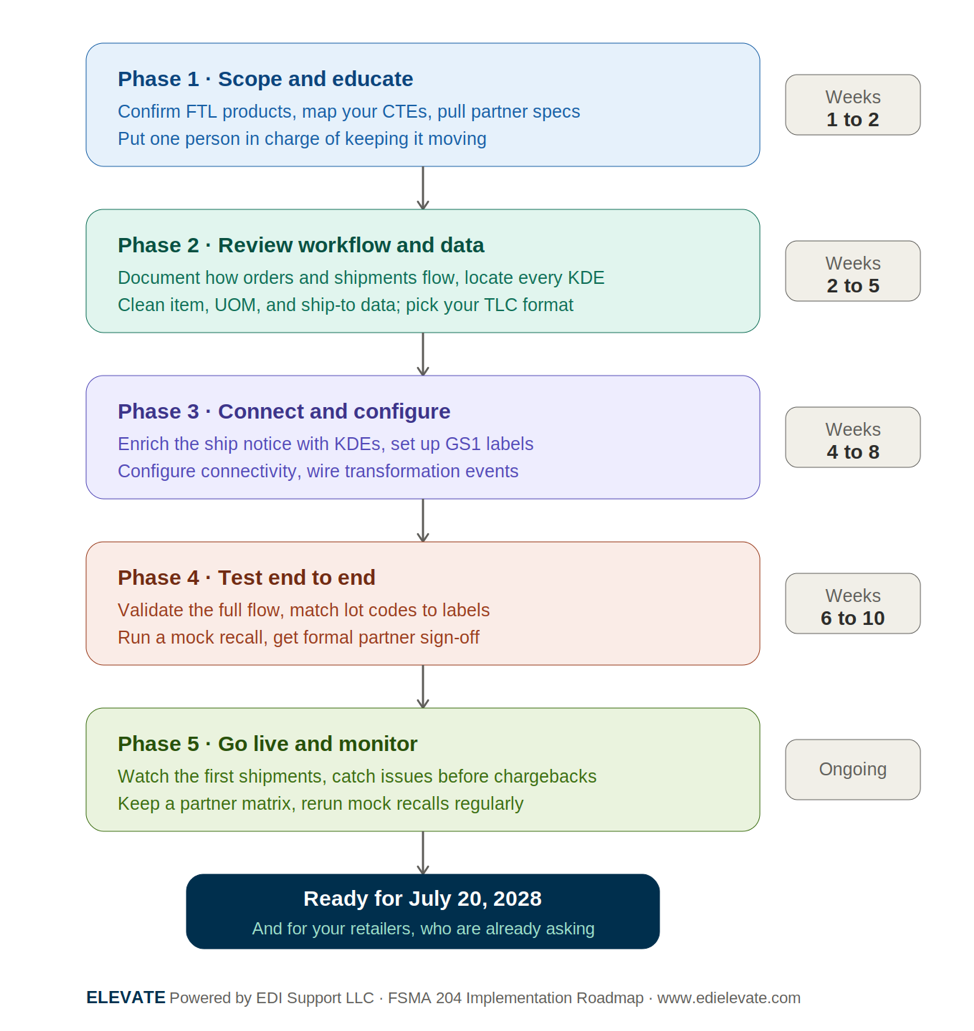
Your FSMA 204 Implementation Roadmap
You don’t need a big internal team. You need a clear sequence, one person who owns it, and partners who fill the gaps. Here’s a practical path.
Phase 1: Scope it out and get educated (weeks 1 to 2)
- Confirm which of your products and ingredients are actually on the FTL.
- Map how those products move through your operation and which CTEs you perform.
- Identify your covered trading partners and pull their current traceability specs, Walmart’s, Kroger’s, and so on.
- Put one person in charge of keeping the project moving. Honestly, this is the single biggest predictor of whether it goes well.
Phase 2: Review your workflow and data (weeks 2 to 5)
- Document how orders, production, shipments, and invoices actually flow today.
- Find every KDE. Figure out which system or document holds the TLC, the TLC Source, the lot, the dates, and the locations.
- Clean up the data that’ll break testing later, item numbers, units of measure, ship to codes, addresses.
- Decide your TLC format. GTIN plus lot number is the common recommendation.
Phase 3: Connect and configure (weeks 4 to 8)
- Enrich your ship notice with the required KDEs and map them to the right segments and qualifiers.
- Set up your GS1-128 case labels and SSCC-18 pallet labels, linked to the ship notice.
- Configure your connectivity (AS2, SFTP, VAN), and an EPCIS API where a partner asks for it.
- Wire up your transformation events so input lots map cleanly to output TLCs.
Phase 4: Test the whole thing end to end (weeks 6 to 10)
- Validate the full flow, partner to EDI to your system and back to the partner, not just “did the file send.”
- Confirm the lot code in the ship notice matches the physical label and markings.
- Run a mock recall. Filter to a lot, generate a sortable spreadsheet, and time yourself.
- Finish any retailer certification and get formal sign off.
Phase 5: Go live and keep watching (ongoing)
- Watch those first live shipments closely. The first transactions are where confidence gets built or lost.
- Keep an eye out for rejections, mismatched labels, and ship notice timing issues before they turn into chargebacks.
- Maintain a trading partner matrix and a change log for when specs get updated.
- Rerun a mock recall now and then, so your 24 hour capability stays real and doesn’t quietly rot.
One tip on sequencing. Start with one partner and your core documents. Get it stable, then roll out the rest in waves. A phased rollout is far lower risk than flipping everyone on at once, and it lets you reuse a playbook that already works.
Common FSMA 204 Compliance Mistakes
- Mixing up your supplier with your TLC Source. This is the single most common data gap.
- Testing only at the EDI or portal layer. A document can look perfect and still fail inside your actual workflow.
- Having no clear owner. Tasks sit for days when responsibility is spread thin across ops, IT, and quality.
- Dirty item and unit of measure data. Most so called EDI problems are really data problems.
- Underestimating the ship notice. Carton hierarchy, labels, and timing make the 856 the most sensitive document you’ll deal with.
- Planning around 2028 while your buyer’s requirement is already live.
- Treating go live as the finish line. The first 30 to 90 days are where most of the real world issues surface.
Want this as something you can actually work through?
We’ve turned these phases into a printable FSMA 204 Compliance Checklist you can bring to your team and your EDI provider.
How Elevate Helps With FSMA 204 Compliance Along with Partners
Elevate is a fully managed, cloud-based EDI platform built for small and midsize food businesses. We offer transparent pricing, real human support, fast onboarding, and no contracts. EDI Support LLC, the team behind Elevate, started out as an EDI consulting practice, helping smaller companies pick providers, switch platforms, and get real end to end support. Support and coordination have always been the heart of what we do.
Before you decide how to build this, it helps to see how the common approaches actually differ for a small or midsize food business:
Approach | Onboarding & FSMA lift | Support model | Best fit |
Retailer web portal / manual entry | You key in orders and ASNs by hand; lot data and labels are your problem | Whatever the portal offers | One partner, very low volume, short term only |
Legacy managed EDI (SPS, TrueCommerce, etc.) | Capable, but add-on fees for new partners, mapping changes, and traceability enrichment; slower queues | Ticket-based, often no dedicated contact | Enterprises with an internal EDI team |
DIY integration platform (Boomi, Celigo, etc.) | Powerful, but you own the mapping, testing, and traceability logic | Your developers | Companies with integration engineers on staff |
Managed EDI + traceability partner (Elevate) | Ship notice enrichment, GS1 labeling, connectivity, and partner testing handled for you; traceability records via Starfish / TrackVision | Real human support, no long-term contract | SMBs that need it done right without building an EDI team |
Note: comparisons reflect common patterns, not any single competitor’s current terms, which change.
For FSMA 204 specifically, we start with your workflow, not with software. Every operation is different, so the right answer begins with understanding how your systems, your people, and your processes actually work together. We handle the EDI side: enriching your ship notice with the required KDEs, setting up your GS1-128 and SSCC-18 labeling tied to that ship notice, configuring connectivity, and driving trading partner testing all the way to go live.
Where our traceability partners come in
Full FSMA 204 readiness almost always reaches beyond any single retailer connection. The industry data makes the point plainly. Roughly 70 percent of food supply chain organizations say they struggle to exchange data between their internal and external systems, and only about one in four have a single, centralized traceability system. That’s a data flow problem, and it’s exactly why we work with a trusted network of partners.
Starfish Network
Starfish Network is a neutral, standards based platform that brings your traceability and EDI data exchange together across suppliers, distributors, and retailers. Instead of locking you into a single vendor’s silo, Starfish acts as the connectivity layer for your whole supply chain, letting you plug in the systems you already run, ERP, WMS, EDI, even spreadsheets, without disruption.
Here’s what Starfish brings to an FSMA 204 program:
- Traceability service. It captures your CTE and KDE events and securely sends them to trading partners over an API, EDI, or file exchange, all while keeping your data private. Then it generates the reports regulators want and lets you analyze the data to run a tighter supply chain.
- Neutral by design. As the only truly neutral platform of its kind, Starfish clears out the silos that proprietary systems create, and translates your data into whatever format each partner expects, GS1, EPCIS, or something customer specific, including the electronic sortable spreadsheets the FDA asks for.
- Fast to stand up. It’s built to deploy quickly with minimal IT lift. Once it’s validated, the data sharing, monitoring, and error handling just run, hands free, in real time.
Pairing Elevate’s managed EDI with Starfish’s connectivity layer gives you both sides of the picture, the retailer facing transactions and the wider traceability network. Compliance stops being a cost and starts being something that actually drives efficiency and real return.
TrackVision AI
TrackVision AI is a supply chain traceability company built natively on GS1 standards. Their platform captures and stores your CTE and KDE records, harvesting, cooling, packing, transformation, shipping, receiving, in a standards compliant, searchable repository, and turns that dreaded 24 hour FDA request into a quick download and send.
On our joint LinkedIn/YouTube Live session below, their team framed FSMA 204 the same way we do. Think of it in four buckets: the inputs, meaning data coming from your suppliers, your own operations, the outputs, meaning data going to your customers, and the FDA’s requirements. Breaking it down that way keeps the project concrete instead of overwhelming. They also echoed something we hear all the time, that most companies aren’t starting from scratch. If you already run EDI with GS1 labeling and ship notices, FSMA 204 is usually just an add on, a few more data elements and a mapping update, not a rebuild.
The whole picture, together: Elevate handles the EDI and retailer compliance layer. Starfish Network provides neutral, interoperable traceability and EDI data sharing across your entire partner network. Traceability specialists like TrackVision AI manage the deep record keeping and the FDA ready exports. Put together, that’s a complete FSMA 204 solution, without your team having to become EDI or traceability experts overnight.
Three Questions to Ask Yourself Before July 2028
- Is your lot information connected to every single shipment leaving your facility?
- Can you identify where a traceability lot actually originated, not just who sold it to you?
- Could your team pull the required records in 24 hours without hand gathering data from a half dozen systems?
If any of those made you hesitate, now is the right time to take a hard look at your workflow.
Ready to learn where you stand?
Elevate helps food manufacturers, distributors, and suppliers connect EDI with their ERP, warehouse, inventory, and fulfillment systems. With partners like Starfish Network and TrackVision AI, we help you build a complete FSMA 204 solution. We start with your workflow, not with software.
Book a complimentary FSMA 204 readiness review and we’ll walk through your setup together.